How to Choose the Right Metal Baler
Key Takeaways
Metal balers help compress loose metal scrap into dense bales for easier handling, storage, recycling, and revenue recovery.
Choosing the right baler depends on material type, throughput needs, facility space, and automation preferences.
Horizontal balers like the HM-60NF are ideal for high-volume metal streams and tough materials.
Vertical balers are space-efficient, cost-effective, and great for lower volumes or mixed materials.
Recycling non-ferrous metals is big business. Non-ferrous metals that are often recycled include aluminum, copper, lead, zinc, nickel, titanium, cobalt, chromium and other precious metals. Of all these metals, aluminum is the most abundant metal in the earth’s crust, and not surprisingly, also one of the most recycled materials today. Recycling non-ferrous metals is important because even new metals require a combined use of secondary metals. Read more about recycling non-ferrous metals here.
Whether you’re processing scrap metal from manufacturing, recycling operations, or distribution centers, investing in the right metal baler can improve efficiency, reduce hauling costs, and support sustainability goals. Metal balers compress and shape scrap into dense, uniform bales that are easier to store, transport, and sell, making them essential equipment for any operation with significant metal waste streams.
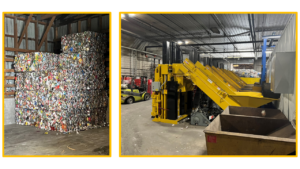
Harmony’s T60XDRC balers make mill-sized bales of aluminum that are easy to stack, store, & transport.
What Is a Metal Baler?
Metal Balers Defined
A metal baler is a piece of recycling equipment designed to compress loose metal scrap, such as aluminum, tin, steel, or mixed metal into tightly packed bales. These dense bales simplify handling, storage, transport, and sale to mills or recycling partners. By consolidating metal into uniform shapes, balers also help facilities improve workflow, reduce labor, and increase the value of outbound material.
Types of Metal Balers
Metal balers generally fall into two primary categories based on orientation and workflow:
Vertical Metal Balers
Best For:
-
Lower volumes of metal scrap
-
Facilities where space is limited
-
Mixed recycling streams that include other materials
Vertical balers compress material from top to bottom and are typically the most economical option. They are manually loaded and often require hand-tying of baled material, which can be suitable for facilities baling occasional or modest amounts of metal.
Harmony Enterprises proudly manufactures the widest range of waste and recycling solutions available on the market. Some of those include vertical balers that are suitable for non-ferrous metal applications. Typically, recyclers prefer non-ferrous bales to be a minimum of 60″, or mill-sized. This makes the bales heavier and easier to stack, store, load, and transport on trucks or in containers. Knowing which one to choose will depend on the type of non-ferrous metal you are recycling, the volume and throughput you need baled, how you need to load the material into the baler, the operational space available to you in your facility, and your overall budget.
Here are just a few of our most popular mill-sized non-ferrous metal vertical balers:
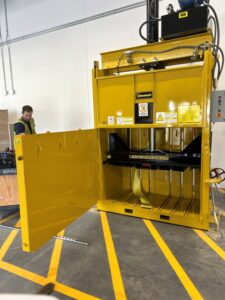
Harmony’s M60-STD is the standard manual load vertical baler for non-ferrous metals.
M60STD – The M60STD Vertical Baler is loaded with features and is the perfect combination of high performance and excellent value. With its powerful 6″ cylinder and larger loading door, the M60STD makes consistently dense mill-sized bales of metals using its impressive 56,550 lbs. ram force.
S60XD/XDRC – The S60XD Vertical Baler offers a unique combination of power and flexibility for any application. Using a 7″ cylinder and 20HP motor, this baler has an incredible 92,360 lbs. of ram force! The XDRC model attaches a conveyor fed system in which metals can be dumped into a hopper and transported into the chamber through the rear of the baler, allowing for automatic cycling.
T60XD/XDRC – The T60XD Vertical Baler can be configured as a unique rear feed baler for use in very high capacity situations as well as a simple front feed system where space is really at a premium.
Horizontal Metal Balers
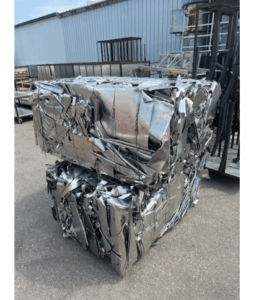 Horizontal balers are designed for higher volumes and tougher scrap loads. Because the material is fed horizontally and the machine cycles automatically, they can handle larger quantities of metal with less manual effort.
Key Benefits:
-
Higher throughput: Faster processing than vertical models.
-
Automation: Many horizontal balers integrate with conveyors, hoppers, and tippers for smooth workflow.
-
Dense bales: Produce larger, mill-sized bales that bring higher resale value.
-
Labor savings: Reduced tying and handling.
Focus: HM-60NF Metal Baler – Heavy-Duty Horizontal Solution
Overview
Introducing the HM‑60NF Non‑Ferrous Horizontal Baler Product Page, a robust and versatile horizontal baler engineered to handle a wide range of metal materials not limited to non-ferrous metals.
HM-60NF Specifications At-A-Glance
-
Bale Size: 30″ H x 60″ L x up to 51″ W
-
Ram Force: 187,000 lbs
-
Feed Opening: 54″ x 40″
-
Bale Weights:
-
OCC: ~1,500 lbs.
-
Litho Plate: ~2,600 lbs.
-
Aluminum Cans: ~700 lbs.
-
Tin Cans: ~1,250 lbs.
-
Why HM-60NF Excels for Metal Balers
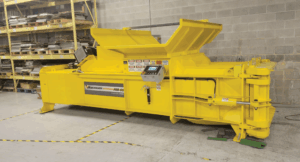 Performance Features
-
High-performance hydraulics: 3,800 PSI system with dual cylinders for consistent compression.
-
Heavy-duty construction: AR400 sidewalls and hardened tool steel shear blades ensure long life and reliability under tough loads.
-
Automatic material retention dogs: Control springy scrap and help produce uniform bales.
-
Full bale ejection: Clears chamber quickly for faster cycles.
-
Switch materials with no shutdown: Flexibility for facilities processing diverse recyclables.
Operational Benefits
-
Remote mounted controls for safer operation.
-
Automatic bale decompression speeds tie-off and door opening.
-
ANSI & OSHA compliance for safe, reliable use.
-
Feed conveyor integration available for automated workflows.
Choosing the Right Baler for Your Metal Stream
When evaluating metal balers, consider these key factors:
1. Material Type & Volume
-
Aluminum & Tin: Often lighter but can be high volume (consider robust horizontal solutions)
-
Mixed Metals: Choose balers that handle variable densities without compromising bale integrity.
-
Throughput needs dictate whether vertical or horizontal is more appropriate.
2. Facility Space & Workflow
-
Vertical balers have a smaller footprint and suit tighter spaces.
-
Horizontal balers require more floor space but support automated feeds and higher capacity.
-
Integration with conveyors, hoppers, and tippers can further streamline operations.
3. Automation & Labor Efficiency
-
Automated tying systems, conveyors, and remote controls can drastically reduce labor costs.
-
Consider how much manual involvement your operation can sustain.
Final Thoughts
Metal balers are indispensable for facilities with significant metal recycling needs. Whether you’re baling non-ferrous metals like aluminum or tougher scrap mixes, the right equipment can make your recycling process more efficient, safer, and more profitable. Horizontal models like the HM-60NF combine power, automation, and durability, delivering dense bales with less labor and higher throughput, making them a smart investment for high-volume operations.
If you’re ready to explore which metal baler fits your operation best, the Harmony team can help you evaluate your needs and recommend the ideal configuration. Call us at (507) 886-6666 or fill out this simple form today!