How To Decide Between a Baler and a Compactor
How-To Tuesday Week 12
Cost vs Value Is the Decision
Choosing between a baler and a compactor starts with understanding your material stream and the role it plays in your operation. When equipment is selected based on material type, volume, and cost structure, it becomes possible to reduce hauling expenses, improve efficiency, and align your system for long term performance.
At its core, the decision between a baler and a compactor is a decision between managing cost and capturing value. The right choice depends on how your material stream behaves and what role it plays within your operation. When that distinction is not clearly defined, equipment decisions tend to solve surface level issues rather than addressing the underlying system.
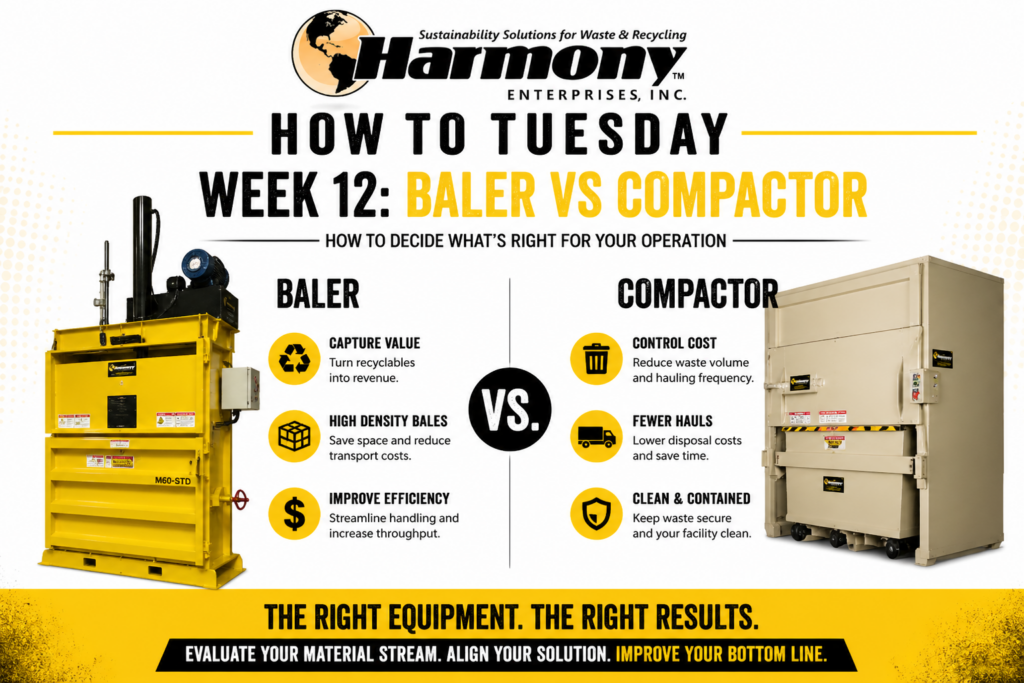
When A Baler Or A Compactor Is A Better Fit
A baler is the right solution when recyclable material volume is high enough to justify separation and processing. Cardboard, plastics, and other recyclables can be densified into uniform bales that reduce storage space, improve transportation efficiency, and create commodity revenue. Without a baler, these materials are often treated as waste, resulting in lost value and unnecessary hauling expense.
A compactor is designed for materials that cannot be economically recycled or are not being separated. Its role is to reduce volume, contain waste efficiently, and minimize the frequency of hauls. For operations dealing with steady waste streams, a compactor provides consistency, cleanliness, and a more controlled approach to managing disposal costs.
Many operations find that waste volume is not the issue, but how that volume is handled. Bulky materials, inconsistent loading, and air pockets can all contribute to increased hauling frequency. A properly utilized compactor addresses these inefficiencies and stabilizes the process, allowing teams to focus less on waste handling and more on core operations.
When the Right Answer Is Both
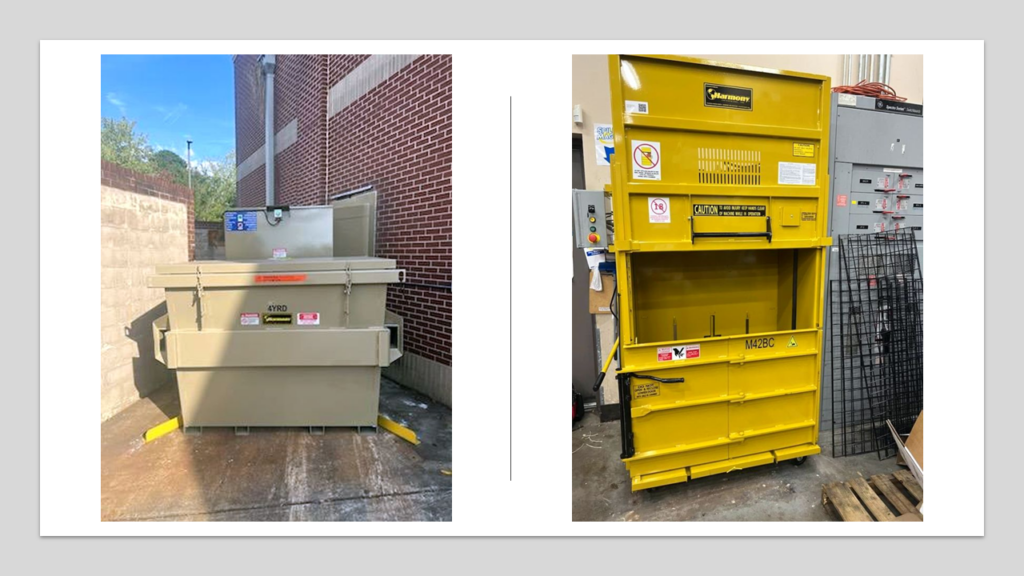 In many cases, the most effective solution is not one or the other, but a combination of both. Recyclables are diverted into a baler to capture value, while remaining waste is compacted to reduce disposal costs. This separation creates clarity in the system and ensures that each material stream is handled in the most efficient way possible.
When both systems are aligned with actual material flow, operations reduce unnecessary handling, improve labor efficiency, and gain greater control over throughput. The result is not just better equipment utilization, but a more balanced and predictable operation overall.
Bring It Back to Your Operation
The right decision is not about equipment alone. It is about your material, your workflow, and the outcomes you are trying to achieve. Evaluating volume, composition, handling patterns, and labor interaction provides the clarity needed to make a confident and effective choice.
If you are unsure which approach is right for your operation, Harmony can evaluate your material stream and help you align your system for both efficiency and cost control. For a more immediate assessment, Harmony’s ROI calculators, available on the homepage and across product pages, allow you to model hauling costs, material volume, and potential savings to support your decision.
We hope you were able to come away with some take-aways during this helpful 12 week How-To Tuesday series to help make your operations more efficient. One final thought as we wrap up: Operational waste is not a disposal issue. It is a systems issue. When the system is aligned, performance follows.