Trash Compactor FAQs
Commercial Trash Compactor Guide & Expert Answers
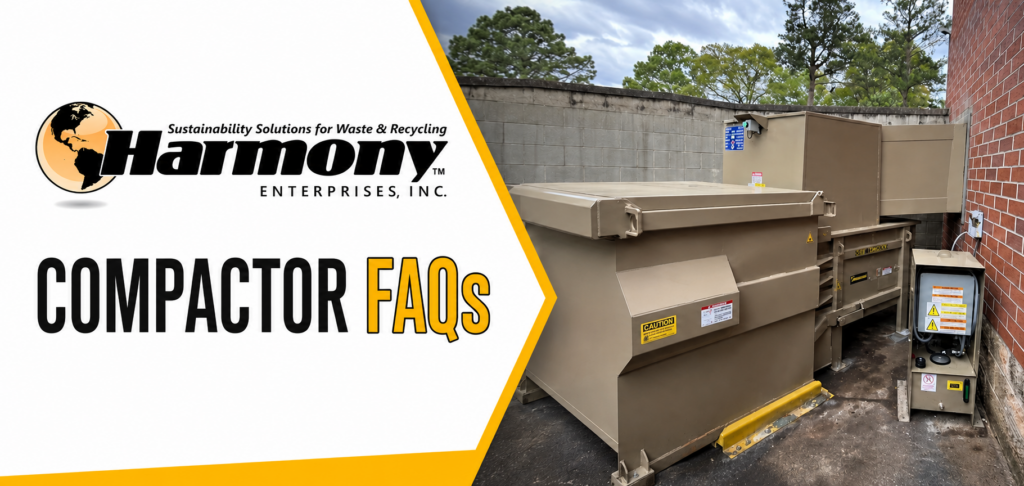 Managing commercial waste efficiently requires more than simply choosing a larger dumpster. The right trash compactor can reduce waste volume, lower hauling frequency, improve sanitation, save valuable space, and create a safer, cleaner workplace.
Harmony Enterprises manufactures a wide range of industrial and commercial trash compactors for indoor and outdoor use, wet and dry waste, public-facing spaces, loading docks, warehouses, healthcare facilities, grocery stores, restaurants, and other demanding environments. This guide explains how commercial compactors work, compares the primary types, and answers the questions businesses commonly ask when evaluating a waste compaction system.
What Is a Commercial Trash Compactor?
A commercial trash compactor uses hydraulic or electromechanical force to compress loose waste into a smaller, denser volume. Unlike a conventional dumpster, which simply stores loose material until collection, a compactor reduces the amount of space the waste occupies before it is hauled.
Commercial compactors are available in several configurations based on the material being handled, where the equipment will be installed, how employees load it, and how the waste hauler empties it. Outdoor stationary compactors are typically used for dry waste, while self-contained compactors are often selected for wet waste or applications requiring greater liquid containment. Indoor, vertical, and automatic compactors provide additional options for facilities with limited space or specialized operational needs.
The right compactor should fit naturally into the facility’s workflow while supporting its sanitation, safety, labor, hauling, and sustainability goals.
Benefits of Using a Commercial Trash Compactor
Loose waste consumes space quickly and often requires frequent handling, storage, and hauling. Compaction creates a more controlled waste process and can deliver measurable operational improvements.
A properly selected commercial trash compactor can:
- Reduce the volume of loose waste
- Decrease waste-hauling frequency
- Lower waste transportation expenses
- Reduce employee time spent handling trash
- Improve housekeeping around waste collection areas
- Help control odors, leakage, pests, and windblown debris
- Discourage unauthorized dumping and employee pilferage
- Improve the appearance of indoor and outdoor waste areas
- Support more consistent waste-management reporting
- Reduce truck traffic and related transportation emissions
Harmony compactors commonly provide a minimum 4:1 compaction ratio compared with loose waste, although actual performance depends on the material, loading practices, equipment configuration, and operating conditions. Learn more about the benefits of Harmony commercial compactors.
Types of Commercial Trash Compactors
Stationary Compactors
Stationary compactors are generally used for dry waste such as packaging, mixed trash, paper, plastics, and other non-liquid materials. The compactor remains at the facility while the detachable receiving container is removed and emptied by the waste hauler. They are commonly used by retailers, manufacturers, warehouses, distribution centers, and other operations that generate significant volumes of dry waste.
Self-Contained Compactors
Self-contained compactors combine the compaction mechanism and receiving container into one connected unit. The entire unit is removed for emptying. Their liquid-containment design makes them a strong choice for grocery stores, restaurants, hospitals, food processors, hotels, and facilities generating wet or food-contaminated waste.
Vertical Compactors
Vertical compactors use an up-and-down compaction motion and are designed for locations where available floor space is limited. They can provide outdoor compaction capacity without requiring the footprint of a traditional horizontal compactor and large receiver container.
Indoor Compactors
Indoor compactors allow employees to manage waste close to where it is generated. They can reduce trips to an outdoor dumpster, minimize the handling of loose trash bags, and improve cleanliness in healthcare, hospitality, food-service, retail, and institutional environments.
Automatic & Front-of-House Compactors
Automatic compactors such as Harmony’s SmartPack models are designed for convenient use in public-facing or employee-accessible areas. They help control waste volume at its source while reducing bag usage, overflow, and the labor associated with routine trash collection.
Choosing the Right Trash Compactor
The best compactor is not necessarily the largest or most powerful model. It is the one that matches the facility’s actual waste stream and operating conditions.
Important considerations include the type and volume of waste generated, whether the material is wet or dry, current hauling frequency, container size, available space, loading height, employee workflow, electrical availability, sanitation requirements, and the waste hauler’s equipment.
Facilities should also consider future growth, seasonal volume changes, accessibility for service, required safety guarding, and whether the machine will be ground-fed, chute-fed, dock-fed, hopper-fed, or loaded with carts or tippers.
A professional waste-stream and site assessment can help prevent investing in equipment that is oversized, undersized, difficult to load, or incompatible with the facility or hauler.
Frequently Asked Questions
Find the Right Trash Compactor for Your Operation
Every facility generates and handles waste differently. Harmony Enterprises can evaluate your waste type, current hauling schedule, available space, loading process, sanitation requirements, and operational goals to help you select an efficient, long-lasting compactor solution.
Whether you need a compact indoor machine, an outdoor stationary compactor, a liquid-tight self-contained unit, or an automatic source-level solution, Harmony offers the equipment range and application experience needed to build a waste-management system around your operation.
Request a Free Waste & Recycling Assessment
Call Harmony Enterprises at 507-886-6666.