Recycling & Commodity Market FAQs
Understanding Recyclable Materials, Quality, Value & Market Conditions
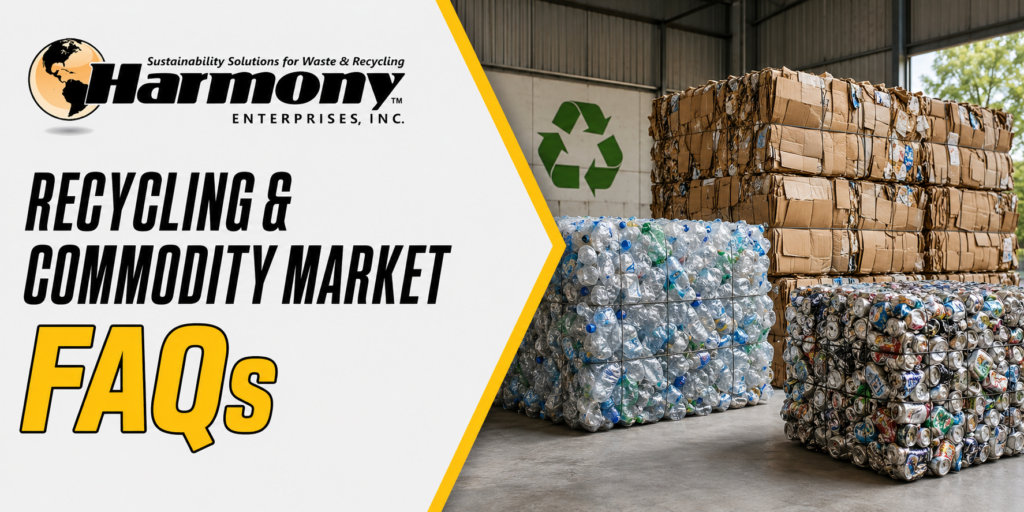 Commercial recycling programs do more than divert material from landfills. When recyclable materials are properly separated, prepared, stored, and marketed, they can become manufacturing feedstock with measurable operational and environmental value.
However, recyclable materials do not have a fixed or guaranteed value. Commodity pricing changes according to supply and demand, manufacturing activity, transportation costs, regional processing capacity, export conditions, material quality, and buyer specifications. A material that produces revenue in one market may carry little value—or even a processing charge—in another.
Businesses have limited control over global commodity markets, but they can control the cleanliness, consistency, density, storage, and preparation of the materials they generate. Reducing contamination, keeping fiber dry, producing consistent bales, separating higher-value commodities, and maintaining accurate records can make a recycling program more resilient through changing market conditions.
Harmony Enterprises manufactures recycling and waste-handling equipment. Harmony does not serve as a commodity broker and does not provide financial or investment advice. Market prices and material specifications should always be confirmed with qualified local recyclers, mills, brokers, haulers, or end users before operational or financial decisions are made.
How Recycling Commodity Markets Work
A recyclable commodity is a recovered material that can be collected, processed, and used as feedstock for manufacturing another product. Common commercial recycling commodities include old corrugated containers, mixed paper, office paper, PET and HDPE plastics, stretch film, aluminum cans, steel cans, nonferrous metals, textiles, and other recoverable materials.
After collection, these materials may pass through a recycler, material recovery facility, broker, processor, or exporter before reaching a mill or manufacturer. Each participant evaluates whether the material meets its quality and preparation requirements.
The final value may be influenced by:
- Supply and demand
- Regional manufacturing capacity
- Domestic and export demand
- Material grade and composition
- Contamination and moisture
- Bale density, weight, and consistency
- Transportation distance and freight expense
- Volume and pickup frequency
- Storage and handling practices
- Labor and processing requirements
- Contract terms and market-index formulas
- Seasonal and economic conditions
Businesses should evaluate the net value of a recycling program rather than focusing only on the quoted commodity price. Equipment, labor, storage, transportation, processing fees, rebates, avoided disposal costs, and contamination charges all contribute to the true financial result.
Material Quality Matters in Every Market
Buyers purchase recyclable material because they intend to process it into another usable material or product. Food, liquids, trash, incompatible plastics, hazardous materials, excessive moisture, and mixed grades increase processing costs and can reduce the amount of usable feedstock recovered.
Clean, consistent material is generally easier to market because the buyer has greater confidence in what each load contains. Quality becomes particularly important during weaker markets, when recyclers and mills can be more selective about the loads they accept.
Good quality begins at the point of generation. Clearly labeled collection points, employee training, source separation, covered storage, correct equipment, and routine inspections can prevent contamination more effectively than trying to remove unwanted material after it has been mixed.
Understanding Price Versus Total Recycling Value
The posted or quoted price for a recyclable commodity is only one part of a recycling program’s value. Businesses may also benefit from avoided landfill costs, reduced dumpster pickups, lower transportation expense, cleaner work areas, improved material handling, and progress toward sustainability goals.
For example, baling corrugated cardboard may produce commodity revenue, but the larger financial benefit may come from reducing the number of trash-compactor pulls or open-top dumpster pickups. Conversely, a high quoted commodity price may not produce a strong return if the facility has excessive freight, labor, contamination, or processing costs.
A useful analysis considers the complete cost before and after implementing the recycling program.
Frequently Asked Questions
Build a More Resilient Recycling Program
Commodity markets will continue to change, but businesses can improve the quality, consistency, density, and handling of the recyclable materials they generate.
Harmony can evaluate your waste stream, material volumes, available space, labor, current hauling expenses, buyer requirements, and sustainability goals to help determine the appropriate recycling equipment.