Baler & Compactor ROI & Financing FAQs
Understanding Equipment Cost, Payback, Purchasing, Leasing & Rental Options
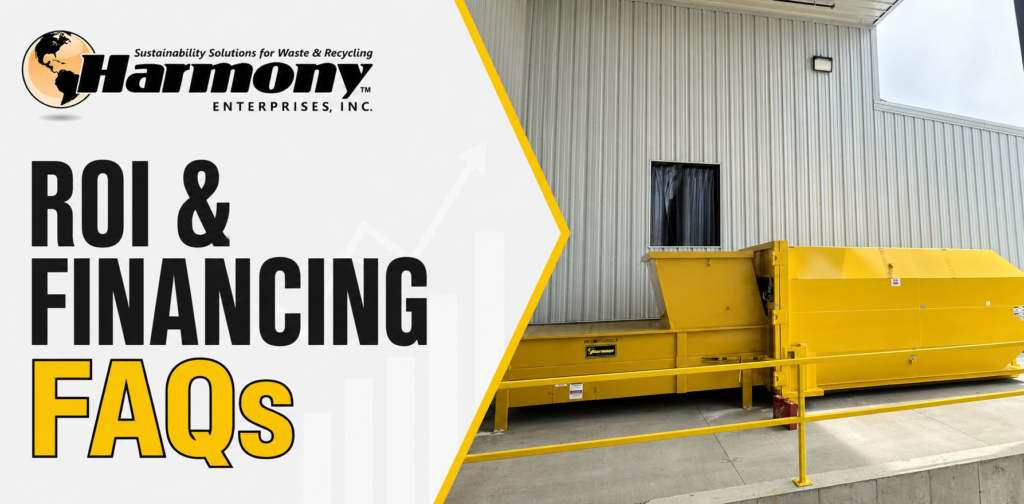 A baler or compactor should be evaluated as an operational investment—not simply as a machine with a purchase price. The right equipment can reduce hauling frequency, improve labor efficiency, decrease waste-storage requirements, lower liner usage, recover recyclable materials, improve housekeeping, and support long-term sustainability goals.
Calculating return on investment requires a realistic comparison between the facility’s current waste-handling costs and the expected costs after the equipment is installed. Commodity revenue may contribute to the return for balers, while reduced hauling, labor, and supply expenses often drive compactor savings. Installation, freight, electrical work, maintenance, financing, and expected equipment life must also be included.
Harmony offers multiple equipment-acquisition options, including purchasing, leasing, and renting. Qualified used equipment may also be available for purchase or lease. The appropriate choice depends on available capital, budget structure, ownership goals, equipment usage, maintenance preferences, accounting treatment, and the flexibility the organization needs.
Financing, lease, rental, and tax terms are subject to approval and may change. Organizations should confirm current terms with Harmony and obtain guidance from qualified accounting, legal, and tax professionals before making a financial decision.
Understanding Equipment Return on Investment
Return on investment measures whether the financial and operational benefits produced by equipment justify its total cost. A basic calculation compares the investment with the annual savings or financial gain it creates. Estimate your potential results using Harmony’s Baler ROI Calculator or Compactor ROI Calculator.
Potential baler benefits may include:
- Revenue from recyclable commodities
- Avoided landfill and disposal expense
- Fewer dumpster or compactor pickups
- Reduced storage requirements
- Lower internal material-handling labor
- More efficient transportation of recyclables
- Improved cleanliness and organization
Potential compactor benefits may include:
- Reduced waste-hauling frequency
- Lower pickup and transportation charges
- Fewer trash-bag or liner changes
- Reduced employee travel and waste-handling time
- Less overflow and emergency hauling
- Improved odor, pest, leakage, and security control
- Better use of indoor or outdoor space
A complete ROI analysis should also include equipment cost, financing expense, freight, installation, electrical preparation, structural work, employee training, supplies, preventive maintenance, repairs, energy use, and expected residual value.
Comparing Purchasing, Leasing & Renting
Purchasing Equipment
Purchasing is often appropriate for organizations with available capital that intend to use the equipment for many years. The business owns the asset and has full responsibility for maintenance, repairs, and eventual replacement. Ownership can provide the lowest long-term acquisition cost when equipment remains in service well beyond the initial payback period.
Leasing Equipment
Harmony partners with third-party leasing companies to offer fixed-payment options on balers, compactors, and liquid-extraction equipment. Leasing may allow a business to obtain the equipment it needs without paying the entire cost upfront. According to Harmony’s current financing information, approved leases may offer no down payment, delayed initial payments, fixed payments, and ownership at the end of the term.
Lease programs, rates, approval requirements, payment timing, and end-of-term terms are subject to current lender conditions and applicant qualifications.
Renting Equipment
Harmony Equipment Rental provides fixed monthly payments and includes maintenance under the rental program. Rental may appeal to organizations that want predictable monthly costs, limited maintenance responsibility, or flexibility to change equipment as their needs evolve.
Harmony currently states that freight and installation are included with qualifying machine rentals and that rental agreements can be renewed under available options. The exact scope, term, service coverage, equipment availability, location, and responsibilities should be confirmed in the final rental agreement.
Measuring Total Cost of Ownership
The least expensive machine to acquire is not always the least expensive machine to own and operate.
Total cost of ownership can include:
- Purchase, lease, or rental payments
- Financing and administrative costs
- Freight and delivery
- Installation and rigging
- Electrical or structural preparation
- Labor and supplies
- Energy consumption
- Preventive maintenance
- Repairs and replacement parts
- Equipment downtime
- Hauling and disposal charges
- Training and safety requirements
- Expected service life
- End-of-term or disposal value
Equipment that provides dependable operation for many years may produce a stronger long-term return than a lower-priced machine requiring frequent repairs or premature replacement.
Frequently Asked Questions
Build the Financial Case for Better Waste Handling
The right baler or compactor can create value through hauling reductions, labor efficiency, recycling revenue, avoided disposal expense, cleaner operations, and long-term equipment performance.
Harmony can help evaluate your current process, estimate operational impact, recommend the appropriate equipment, and explain available purchase, lease, rental, and used-equipment options.