Baler & Compactor Installation FAQs
Expert Guidance for Baler & Compactor Installation
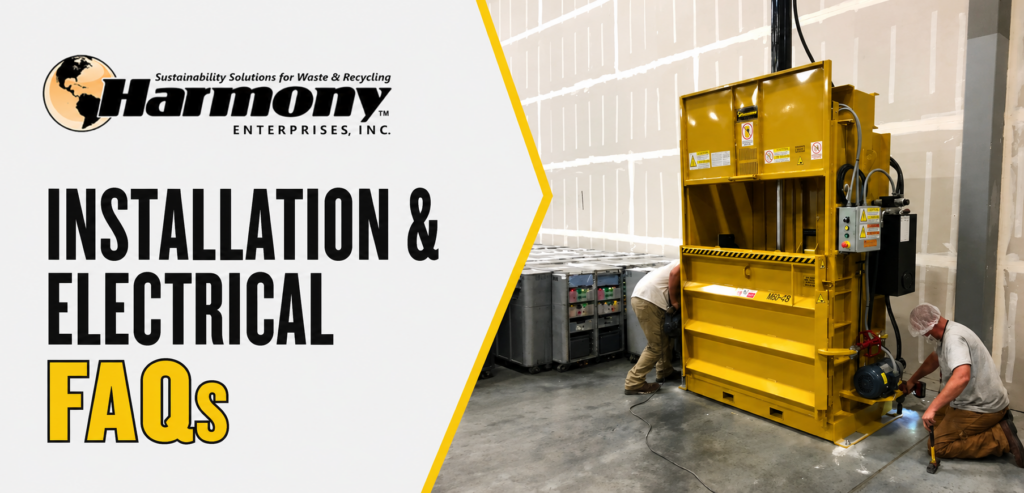 A successful baler or compactor installation begins well before the equipment arrives. Electrical service, available space, floor conditions, delivery access, equipment clearances, material flow, employee safety, and waste-hauler access all influence whether a new machine can be installed efficiently and operated reliably.
Failing to address these requirements in advance can lead to delivery delays, added electrical work, unexpected construction costs, improper equipment placement, or a machine that does not fit the facility’s workflow. Early coordination among the equipment manufacturer, facility manager, electrician, installer, general contractor, waste hauler, and safety personnel helps prevent these problems.
Because every Harmony baler and compactor has its own specifications, the equipment’s approved drawings, electrical requirements, and owner’s manual must guide the final installation. The information below provides general planning guidance but does not replace model-specific documentation, applicable codes, or work performed by qualified professionals.
Planning a Successful Equipment Installation
Installation planning should begin as soon as the equipment model and proposed location are identified. The facility should confirm that the machine will physically fit in the intended space, can be transported through the building, has access to the correct electrical service, and can be safely loaded, operated, cleaned, maintained, and emptied.
Important planning factors include:
- Equipment dimensions and operating footprint
- Shipping dimensions and orientation
- Door, hallway, elevator, and dock clearances
- Ceiling and overhead utility clearance
- Floor condition and load-bearing capacity
- Electrical voltage, phase, amperage, and frequency
- Disconnect and overcurrent protection requirements
- Distance from the electrical source
- Indoor or outdoor placement
- Temperature, moisture, and environmental exposure
- Loading method and employee workflow
- Bale or waste-container removal
- Forklift or pallet-jack access
- Waste-hauler approach and container-exchange space
- Required guarding, platforms, chutes, decks, or enclosures
- Service and preventive-maintenance access
- Applicable building, fire, electrical, OSHA, and ANSI requirements
Completing these reviews early gives the facility time to obtain contractor estimates, schedule electrical work, prepare the installation area, and coordinate delivery.
Understanding Baler & Compactor Electrical Requirements
The electrical service required depends on the specific machine, motor horsepower, voltage, phase, controls, optional accessories, and installation environment. Smaller balers and indoor compactors may be available in single-phase or three-phase configurations, while larger balers and outdoor compactors commonly require three-phase power.
Facilities should never assume that an existing outlet, disconnect, or circuit is suitable simply because another piece of equipment previously operated in the same location. The voltage and phase must match the machine nameplate and approved electrical documentation. Circuit capacity, conductor size, disconnects, grounding, overcurrent protection, and local code requirements must also be evaluated.
A licensed electrical contractor should review the equipment requirements before delivery. If the facility does not have the necessary electrical service, additional work or coordination with the utility company may be required.
Choosing the Right Equipment Location
The best equipment location supports the complete material-handling process. Employees should be able to load the machine without creating unnecessary travel, congestion, or exposure to vehicle traffic. Finished bales, compacted waste cubes, or containers must also be removed safely.
The location should provide adequate space for doors, controls, bale ejection, container movement, cleaning, inspection, and maintenance. Electrical panels, disconnects, emergency stops, and safety labels must remain accessible.
Outdoor compactors require additional planning for concrete pads, drainage, weather exposure, traffic protection, enclosure design, and waste-hauler access. Chute-fed and dock-fed installations must coordinate equipment dimensions with the building opening, dock height, loading direction, guarding, and container-exchange path.
A convenient loading location is not automatically a suitable installation location. The full equipment lifecycle—from delivery through daily operation and eventual service—should guide the decision.
Frequently Asked Questions
Prepare for a Successful Equipment Installation
Every facility, machine, and installation environment is different. Harmony can help you evaluate available space, equipment dimensions, material workflow, electrical requirements, delivery access, loading configuration, and service needs before your baler or compactor arrives.
Early planning helps reduce delays, control installation costs, and ensure that the finished system supports safe, reliable, and efficient operation.